


In Search of the Perfect Cup
From Micro Lots to Church Coffee, “Perfect” is Personal
WRITTEN BY MARK CASEY AND BRENYA HELMIN
“I can see why people sell everything and move here.” The thought comes to me while walking the side of a volcano on the Big Island of Hawaii. Karen Paterson guides me through “Hula Daddy,” her Kona-certified coffee plantation. Its exclusive geography legally permits Paterson to brand her beans as “100% Kona.”
Earlier, a blend of just 10% Kona coffee rescued my day. A dark French roast from Lion, a staple brand here, delivered a burst of aromatic heat, steam, earth; flavors reviewers call “aggressive.” I call it prescriptive for flight delays, time zone changes, and an unfortunate dinner wine choice.
Karen and her husband, Lee, arrived from California in 2002 to open their farm in a Big Island cow pasture. Early results were tasty. Still, the couple wanted better. They acquired additional land on the volcano at 1,400 and 2,500 feet. The elevation ensures coffee trees get the best of two climates, enveloped in cooler moist air in the morning, giving way to tropical sunlight as the fog layer lifts in the afternoon. Moisture, volcanic soil, and elevation are what make Kona coffee. Expertise helps too, and here’s where Minnesota’s vaunted coffee culture went Hawaiian.
“There was a guy in Minneapolis who kept getting really good scores from Coffee Review,” Lee Paterson recalls. Coffee Review is a publication whose 100-point scale is industry standard for rating beans and roasts. “He would bring green coffee into Minneapolis, roast it, and get these top scores. So I called him and said, ‘Listen, if I sent you one hundred pounds of our coffee, would you roast it?’”

Miguel Meza’s perfect cup obsession led him from Minneapolis to Hawaii. His company, Paradise Coffee Roasters, consistently produces award-winning beans from around the world (photo provided by Miguel Meza and Paradise Coffee Roasters).
He” was Miguel Meza. At age sixteen, Meza fell in love with specialty brews while working at Twin Cities cafes. With family help, he opened Paradise Roasters. After high school, Meza searched worldwide for exotic beans while honing his roasting techniques. Paterson’s call opened a door. Meza spent two years at Hula Daddy, completely overhauling their cultivation, harvesting, and roasting processes. He hit the industry summit, an unprecedented ninety-seven rating from Coffee Review with Hula Daddy’s “Kona Sweet.” Then he was off to grow and source his own specialty beans, re-establishing Paradise Coffee Roasters in Hilo, always in search of his “perfect cup.”
For Meza, the ultimate coffee experience is almost spiritual. “Complex and complete, having a lot of every attribute, but in balance and in harmony, where nothing really, I guess, is overpowering, but nothing is lacking either,” he says. “It needs to be aromatically complex in that the aroma has high acidity, very full, round mouth, feel balancing sweetness. Achieving perfection is extremely difficult. It’s not impossible.”

Hula Daddy co-founder Karen Paterson inspects a coffee tree on her plantation. Each tree is planted, maintained, and harvested by hand (photo by Mark Casey).
What is It About Minnesota and Gourmet Coffee?
In the 1990s, Minnesota leaders were focused on developing better policies for state farmers shredded by the 1980s recession. In a strange serendipity, the effort led to the discovery and nurturing of specialty coffees in the tropics. The lodestar was equity and social justice.
Drawing on the mid-twentieth century ideas of Governor Harold Stassen (1939–1943), the movement created “fair trade.” Farmers became partners, building markets worldwide, paid based on their production costs, guaranteeing profits. As Stassen’s post-World War II fair trade practices reached coffee growers in the 1990s, the growers ditched factory farming in favor of developing distinctive beans.
That hadn’t always been the case. To satisfy America’s surging coffee habits in the nineteenth and twentieth centuries, multinational food processors churned out roasted beans—think the two-pound tin of Maxwell House or Folgers. Third World producers were squeezed.
In 1996, fair trade pioneer Mark Ritchie, who in 2011 would become Minnesota’s secretary of state, partnered with Mexican farmers and created Minneapolis-based Peace Coffee. Its social justice vibe found a ready market among advocates in Minnesota churches. Its rich taste recruited unlikely missionaries in high-end Twin Cities restaurants: the wait staff.
To waiters, coffee was a commodity. Now, hooked on new distinctive flavors, they introduced diners to coffee akin to fine wine. A few very passionate believers leveraged life savings for trips to source unique beans around the world. Waiters evolved to importers and specialty roasters. Their timing was fortunate.
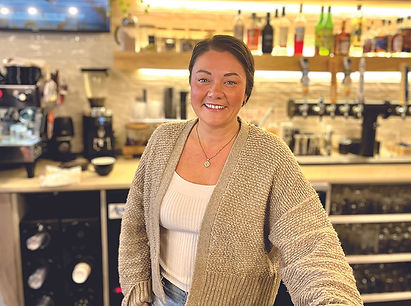
Minnesota Traders Company owner Natalia Maher finds the search for the perfect cup a passionate journey (photo by Brenya Helmin).
By the 1990s, Starbucks had invented a multi-recipe beverage experience. Suddenly, so-called “artisan coffee” from around the world, roasted to maximize taste, was in reach of everyday consumers. Today, there are many Miguel Mezas creating beans with farmers worldwide and delivering unique roasts to Main Streets everywhere—including the Brainerd Lakes region.
Walk into Minnesota Traders Company, a coffee bar and restaurant in Pequot Lakes, and owner Natalia Maher is ready with a hot or cold brew plus information on the source.
“People are starting to pay more attention. We’re past what they call ‘the Third Wave of coffee.’ Certain people are starting to source down to the lot,” Maher says, explaining what’s become a typical interaction with customers, especially Twin Cities tourists. “Instead of just saying this whole region of Costa Rica has coffee, we’re narrowing it down to this particular farmer, this particular area of the farm, and this particular row and variety. They call them black micro lots.”
“Micro lots” are small, specialized batches harvested and processed separately from a bigger farm or estate.
“Coffee has such a story, and it’s such a passionate subject,” says Maher. “The only way to explain that is to know somebody who’s been there, or to have been there firsthand yourself.” Maher has witnessed it in Costa Rica, where they source. “See the farmers growing the crop. See people handpicking cherries and hand-selecting them, and then going through the beans after they’re roasted and throwing out the ones that aren’t perfect. It really makes you think, ‘wow, my cup, it’s not enough money,’ even though coffee is pretty expensive and it’s going up.”
Still, business is good and growing. At Reality Roasters in Little Falls, owner Nathan Diehl is brewing Guatemala Hue Hue, Java beans from Indonesia, and local favorite “Uffda Express,” a dark roast, rich, smooth, and chocolatey. Diehl is also selling an absolutely essential element for the perfect cup: community. Done well, the social experience relegates beans to a complementary role.
Reality Roasters owner Nathan Diehl (far right) with wife Melissa (middle) and Office Manager Julie Johnson (left). Nathan believes finding the perfect cup is largely about finding community (photo provided by Reality Roasters).

“It creates so much community. That’s one thing I really love about the coffee industry,” Diehl says, working the counter on a busy weekday. “People are happy to sit down and visit and build relationships over that cup of coffee.”
“I don’t think I would want a cup of coffee at a diner or a small-town breakfast place to be a super exotic profile,” explains Noah Namowicz, chief operating officer of Minneapolis-based Café Imports, whose Indonesia Java is brewed at Reality Roasters. “There is a time and place for certain kinds and different types of coffees. High quality coffee rooted in progressive sourcing practices can still be approachable to the average consumer.”
Café Imports was founded in the fair trade movement and connects farmers worldwide with local shops. Though Noah’s business is built sourcing specialty beans, he sees the “perfect cup” as whatever makes the drinker happy.
“Happy” on a January morning is at a familiar place in small-town Minnesota, a breakfast café in Foley. There, my colleague Brenya Helmin, who works as a barista, found plenty of happy, everyday coffee drinkers.

Noah Namowicz is chief operating officer of Minneapolis-based Café Imports. Despite the challenges of international trade and changing climate, he expects innovation and demand will keep artisan coffee thriving (photo provided by Noah Namowicz and Café Imports).
The Regulars
My alarm goes off at 4 a.m. sharp. I drag myself out of bed for the opening shift at my local coffee shop. There, I carefully craft countless orders of “perfect cups” for commuters facing the day ahead. With each pour, my coffee obsession (or addiction) grows. My perfect cup, packed with the punch of four or five espresso shots, disappears in seconds.
This day, I sleep a little later, because I’m going back to my roots—Jack and Jim’s in Foley—where I once waited tables serving the regulars, who each have their own idea of a perfect cup. I wanted to visit with the people I once helped.
As always, the menu on this slow Sunday morning includes plates of fried eggs, buttered toast, and bacon, all washed down with endless cups of fresh, hot coffee. Coffee drips leisurely into percolators, ready to satisfy the caffeine cravings of eager sippers. They pour through the door, bundled up and shivering. Their weapon of choice to combat the chill? A glorious cup of joe.
The roast savored here wasn’t born from the volcanic soil of Kona, or crafted masterfully by a seasoned barista. There’s no specialty roasts or flavorful creamers. You won’t find cortados or espresso con panna. Here, there is only one kind of coffee on the menu—a hot, tasty, and affordable “bottomless cup” you can sip all morning long. It may be a far cry from a brew made from premium or exotic beans—yet each morning, gallons of “perfect cups” are downed by customers ordering it by the pot.
Mary Pettitt savors her usual omelet order, fork in one hand, coffee cup in the other. Her brew comes from the revered red tin of Folgers gracing the shelves of countless cafes, churches, and homes. “I remember the days when coffee was just coffee,” says Mary as she happily enjoys her perfect, no-nonsense cup. To Mary, the best coffee is whatever’s on sale—no spending on elaborate lattes or high-end beans. “I don’t do none of that business, just black.”
Over a lifetime, Mary and coffee forged a companionship different from the typical “wake-me-up” cup. Her connection comes from pure enjoyment, the assertive flavor, and the warm-up on brutally cold Minnesota mornings. It’s tradition and connection, cup by cup. She admits to being a caffeine addict, but swears she could quit coffee anytime. Pouring herself another, she adds with a smile, “The doctor told me to cut back, but what do they know?”
For every Mary, adamant about the joys of a Plain Jane cup, there’s the heavy-handed cream and sugar crowd. Nearby, Craig Lieberg empties another creamer container into a cup easily mistaken for a mug of milk. His mix this morning of four half-and-half containers, four packets of sugar, and a splash of joe may leave some wondering if Craig even enjoys coffee.
“People ask me, ‘Why don’t you have some coffee with your creamer?’” He jokes and gulps down his perfect cup.
With a wink, Craig shares another secret. The true reason he drinks coffee is so he can have breakfast with his good friend Don, who’s joining us at the table. They swap memories of mornings on the farm where they sipped “egg coffee” (an old school recipe that includes separating the yolk from an egg, scrambling it, then adding it to a pot of boiling coffee) while the mounting pile of emptied sugar packets and creamers continues to grow.
Coffee “Waves”
-
“First Wave” (1800s-present) – factory farmed, packaged in tins or powder. Mass market affordable but lower grade.
-
“Second Wave” (late 1980s-early 1990s) – Starbucks, Peets, Caribou bring coffee shop culture to middle America at a commercial scale. It’s a “third place” – not home or work – to visit friends, hear music, and read while “experiencing” exotic brands.
-
“Third Wave” (early 1990s–present) – led largely by Minnesota’s fair trade practices. Waiters market coffee to customers one-on-one, selling exclusivity tied to place and flavor. Beans, sourced from small farms and roasted to deliver a proprietary taste—called a profile—found a larger targeted and smaller boutique market.
-
The “Fourth Wave” (now) – home brewing using sophisticated and expensive machines, scales, and very pure water. Applies precise scientific methods to water temperature, grinding, and portions, seeking a profile maximizing taste and aroma.
Retired couple Darrell and Michelle Watercott welcome me to their table. Michelle and coffee have history, a love affair she’s committed to longer than her marriage. When she was just a few years old, her grandparents introduced the daily ritual via bread dipped in a mix of sugar and coffee. This made the brew essential to starting Michelle’s day. She tells me missing a cup now “feels like I forgot to put on a shirt.”
While it didn’t take long for Michelle to fall in love with coffee, Darrell wasn’t easily convinced. Until he started working at what he coined the “world’s most boring job,” Darrell avoided guzzling the drink he once denounced as “dirt water.” Now, it powers him through his days. “For Americans, it’s a necessity,” he explains. “It’s something you get used to. You have it with your meals. You need it to get you through your day.”
While the coffee I sampled this morning does not welcome me to the world of groundbreaking flavors, what I found is something far more profound. The “perfect cup” has little to do with flavorful ecstasy—but, rather, it’s the connections we share over our cups. They’re the cups of coffee my grandma would make for my grandpa; the cups of coffee that my grandpa would sneak me a sip of as long as we kept it between us. As I ponder this, I find myself going back for another sip, then another. It’s nostalgia, served comfortingly sentimental.

Steve Kraus and his wife, Tram Mai, started Press Coffee during the 2008 recession. Demand for Press has led to grocer agreements with Sprouts and Shamrock Foods. The couple recently acquired plantations in Panama (photo by Mark Casey).

Press Coffee Roaster Jeff Webb “cups” multiple roasts in search of the best profile. It’s a consistent, repeatable process, focusing on careful preparation, meticulous tasting, and detailed notes (photo by Mark Casey).
A Pricey, Endangered Perfect Cup
Whatever “Wave” delivers your perfect cup, it’s costing more. Recently, roasters have paid as high as $18 a pound from just $2 two years ago, the most expensive ever. The twin existential threats of climate change and global politics are the main reasons.
“There’s been a major frost in Brazil. They’re the largest producer of coffee. They had twenty million coffee trees get ruined, frozen,” says Steve Kraus, whose Phoenix, Arizona-based Press Coffee is a rising specialty roastery. Kraus says he’s no climate activist. However, changing conditions in the “coffee bean belt”—a geographic region between the Tropics of Cancer and Capricorn with all the world’s coffee beans—has his attention.
“There are experts who think coffee will disappear in sixty years. Or there’ll be such a small amount, it’ll become something consumed only by the elite,” Kraus says.
But Café Imports’ Namowicz sees hope in better coffee products evolving throughout the coffee belt. “I think the quality generally gets better year after year,” he says. One reason is that farmers use technology to improve outcomes. “They go online and consume educational resources to help them grow better coffee. So I think that’s super, super exciting.”
Meanwhile, as fall settles in Minnesota, Jenna Radley sits with my colleague Brenya talking about the perfect cup. A regular at Jack and Jim’s and a mother of twin boys, Jenna is going Fourth Wave at home today. It’s the simple pleasure of a slow morning, where she savors each sip, carefully crafted in her perfect cup, exactly the way she prefers it.
“That way I can drink in peace and hang out with my kids,” she says.
Jenna tops her brew with spiced cinnamon creamer and a luscious cold foam. When she takes that marvelous first sip, there’s one thing on her mind: “It’s about time.”