


Get Swept Up
Curling in Lake Country
Balance and stability help BLCA member Brent Gunsbury deliver the forty-two-pound granite curling stone. A slight turn of the handle as the stone is released makes it curl down the sheet of ice.
WRITTEN BY JENNY GUNSBURY | PHOTOGRAPHED BY JEFF COLLINS
“Sweep! Hard, hard, hard! Off. . . Let it curl. . . Sweep!”, This urgent string of commands can be heard almost every evening mid-October through March at the Brainerd Lakes Curling Association (BLCA). It’s the voice of the skip (team captain) telling the sweepers what to do as they follow a forty-two-pound curling stone sliding down a sheet of ice from one end to the center of the rings on the other end. Curling may appear like shuffleboard on ice. But it’s more than that. The multiple health benefits, the fun social nature of the game, the underlying philosophy of friendly competition, and the strategy that rivals a chess match—these all go into making the sport a game changer for getting through our long, cold, Minnesota winters.
It was one of those long winters that finally got to Toni Czeczok, a longtime BLCA member. “When our daughter graduated from high school,” she says, “I knew I would have time on my hands, especially in the winter. It was January 2012, and the club was just opening, so I thought I’d try it. I was hooked from the very first time doing it!” she recalls.
Czeczok has been one of the leaders at the club ever since and is a strong advocate for the sport. She regularly invites new people to come try it out. “Seeing new people fall in love with the game and then noticing them improving and making progress in their skills is so fun,” explains Czeczok. “Even in my own game, it’s exciting to still work on getting better.”
Gaining new skills is just one of the benefits of the sport. Sweeping the rocks, gliding low on the ice to deliver the stones, and doing an average of over two miles of “steps” during a typical game provides a wonderful aerobic workout, increases balance and flexibility, and strengthens muscles.
“It’s also a lifetime sport,” says BLCA member Dusty Nelson. He’s involved with the Junior/Youth and Adult Learn to Curl programs and is himself a curler with thirty years of experience. “I’ve curled with six-year-olds up to ninety-year-olds, people in wheelchairs, and people with hearing or sight impairments. It can be a sport for everyone.” Adaptive equipment, such as stabilizers and delivery sticks, makes it easy for people who have balance or joint issues to play the game. The BLCA also has smaller stones, so kids as young as five or six can learn.
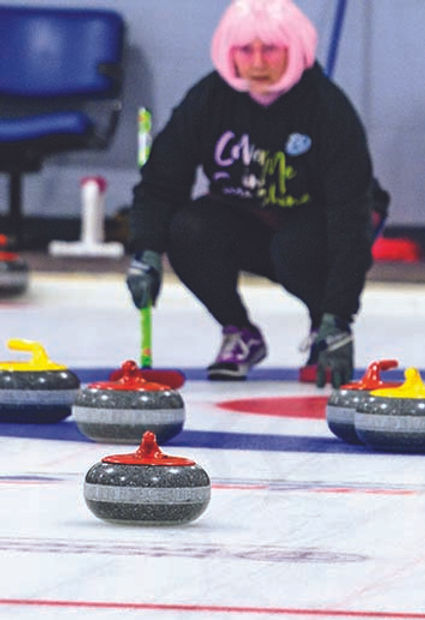
Brief Overview of Curling
Teams consist of four players: skip, vice-skip, second, and lead. Each team has eight rocks, or stones. During an “end,” players take turns delivering the stones, alternating with players on the opposing team. For each stone, the skip calls the shot from the far end, giving direction to the thrower where to aim and which direction to curl the stone as it leaves their hand. The two remaining teammates follow the stone as it slides toward the “house” (bullseye or target) at the other end, sweeping the ice ahead of the stone if necessary to bring it into the desired position. Once all sixteen stones are thrown, the team with stones closest to the “button” (center of bullseye) scores. Play continues for eight ends, and the team with the highest score wins.
John Kelsch, now in a consulting role at the Judy Garland Museum, sits in the star’s childhood living room (photo by Allison Sandve).
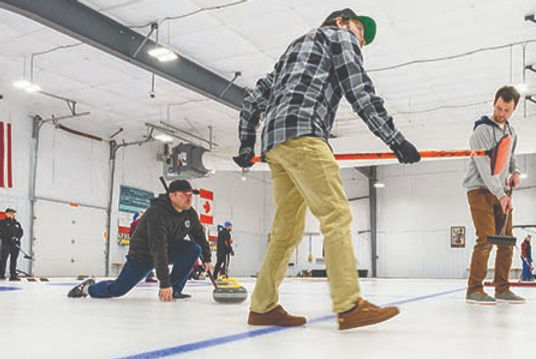
Chris Hamm, Bemidji, and his team compete in BLCA’s Rock & Beer Bonspiel. The club hosts the annual curling tournament in January.
“Especially for youth, curling can teach important lessons,” believes Nelson. “It promotes healthy social interaction as well as fostering friendships, teamwork, leadership, mental focus, and problem-solving skills.” The strategy is actually one of Nelson’s favorite parts of the game. “I like to plan five to seven shots ahead,” he explains. “There are certainly good calls and bad calls but really no wrong shots.”
Then there’s what players call the “spirit of curling.” “It’s a term we use regularly in the sport, and it can mean something slightly different to every curler,” describes Nelson. “The overarching theme is ‘Let’s have a good game, cheer for all good shots, call your own infractions, and have fun.’ The spirit of curling is something that can be applied to more than just the sport.”
The social aspect of curling is unique. In most sports, teams typically leave the stadium, arena, or court after barely a handshake. At the start of a curling game, however, each player shakes hands with each of their opponents and wishes them “good curling.” At the end, players come off the ice, share a table in the warm clubhouse, and socialize over a beverage and popcorn. Conversations might include kudos for best shots of the game, but mostly it’s a chance for players to get to know one another.
This tradition can also make the world of curling feel accessible. Nelson notes, “When I play at another club, I already know that I’ll be making friends and meeting new and fascinating people. The curling world is still a small family, after all, and connections are easily made.” This is especially true in Minnesota, where it’s easy to find curlers who’ve competed at the national, world, and Olympic levels. “In what other sport can you go to a competition, visit with or compete against Olympians, and then have them come play at your club?” asks Czeczok.
The 245-member, all-volunteer BLCA club offers plenty of activities to get involved in. Besides classes for youth and newcomers, there are men’s, women’s, open, doubles, and junior leagues. Over the years, the youth program has ranged from ten to sixty kids a season with club members volunteering their time and expertise to teach and coach.
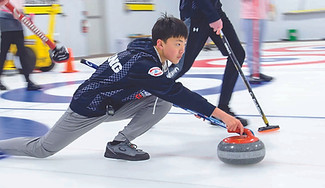
Zach Wang (Chaska Curling Center) competes in the Rock & Root Beer Junior Bonspiel in Brainerd. The BLCA hosted their first junior event in November 2024. It attracted young curlers from around Minnesota.
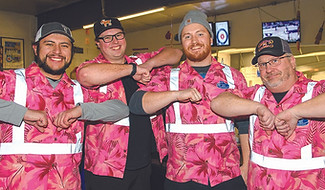
BLCA members Tim Thorson, Nick Weeks, Jace Stallman, and Mark Myhre in the club’s viewing area during Rock & Beer Bonspiel.
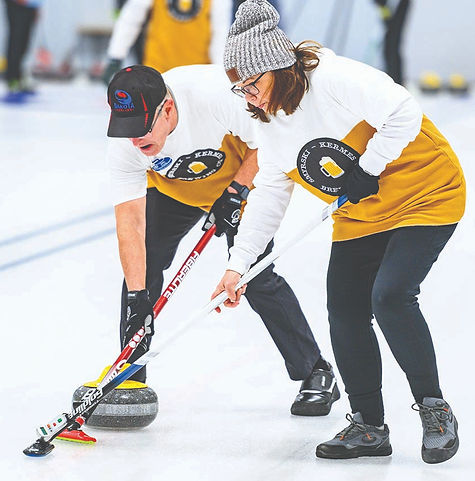
Bonspiel participants John Smyrski and Lisa Backer work to get their stone in the spot directed by their skip. Sweeping in front of the stone keeps it on a straighter line and makes it slide farther.
Bonspiels, or curling tournaments, are held several times a year and are great fundraisers for the BLCA. They typically start on Friday evenings with first-round bracket games and end with championships on Sunday afternoon. In between are raffles, live music, games of chance, and lots of camaraderie. Meals and beverages for the entire weekend are covered by entry fees and provided at the club so curlers can just show up ready to play. Bonspiels can be serious or have humorous themes, with costumes often encouraged. Even so, games are still competitive, just with a side of fun.
The club’s central location in Minnesota makes it a popular venue not only for regular bonspiels but also state and national championships. “We’ve hosted the Minnesota State Men’s Senior Bonspiel Championships, the Minnesota Women’s Gopher State Bonspiel, and the USA Curling Club Nationals Bonspiel,” says Czeczok. “That’s been quite an honor for a fairly new club but speaks volumes about our enthusiastic and hard-working volunteers.” In November 2025, the club also held its highly successful second annual “Rock & Root Beer” Junior Bonspiel with competitive and developing team brackets.
Not only does curling offer health and social benefits to the players, it’s also a great asset to the community.
Brainerd Lakes Curling Association opened its dedicated curling facility in 2012 with a generous donation from the late community philanthropist Fran Holden. The building is shared with the Crow Wing County Fair Association. “Two local nonprofits can use the building year-round, for six months each,” explains Czeczok. “Besides league nights, the BLCA offers curling experiences for local organizations and businesses, team-building events, and fundraisers in the winter. The fair association rents the facility for weddings, rock and gem shows, and 4H use in the summer.” Bonspiels also bring tourism dollars to the area and visitors from across the nation and parts of Canada.
When curling originated in Scotland in the sixteenth century, players slid rocks on frozen lakes and ponds. “Curling” refers to the rotation of the stone as it moves across the ice. Sweeping the ice ahead of the stone can influence the amount of curl, direction, and speed. Rules and formal clubs followed by the early eighteenth century. When the first winter Olympics were held in Chamonix, France, in 1924, curling was one of the five original sports, along with Nordic skiing, bobsledding, skating, and ice hockey. Its appearance at the games was sporadic over the next few decades but has consistently appeared since 1998.
As the 2026 Winter Olympics in Italy are about to start, the BLCA is gearing up for added curiosity about the sport. “Curling is in the top ten most popular Olympic Winter sports,” says Nelson. “For the general sports fan, curling is not widely accessible to watch, but during those two weeks of the Olympics, people are fascinated by it. That fascination leads many to see what is available locally.” Czeczok adds, “Our Learn to Curl classes are very popular in Olympic years! We’ll also try to do a four-hour intro class to teach the basics followed by a pick-up league so new players can get some practice.”
Ready to change your winter game? Head on over to the Brainerd Lakes Curling Association to see the action. Maybe try throwing a stone. Prepare to get “swept up” in the sport.
Editor’s Note: For more information, check out brainerdcurling.org, visit at 2000 13th Street SE, Brainerd, or email brainerdlakescurling@gmail.com.
Upcoming Events
-
13th Annual Open Bonspiel
December 5–7, 2025 -
Rock & Beer Spiel
January 23–25, 2026 -
Rolling Doubles Bonspiel
February 13–15, 2026 -
Gopher State Women’s Bonspiel
March 6–8, 2026 -
Fran Holden Memorial Bonspiel
March 21–22, 2026
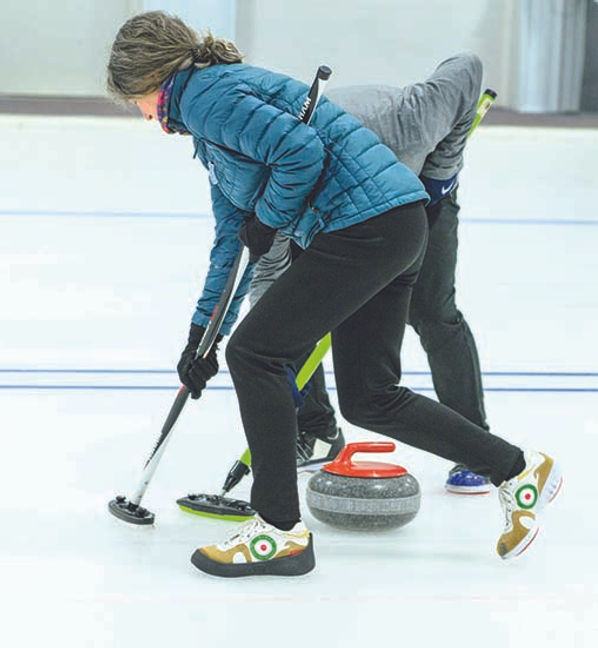
Jenny Gunsbury and Mark Ambroz (BLCA) sweep hard to keep the stone on the desired path on its way to the house.
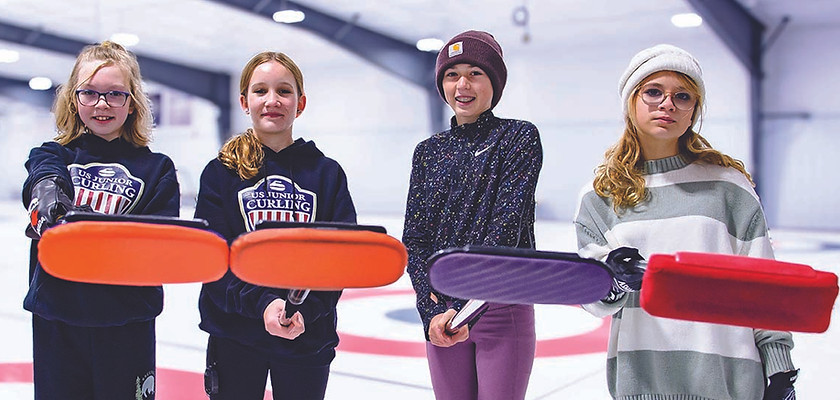
L to R: Luci Viehauser (BLCA), Penny Strot (St. Paul Curling Club), and Wren Zimmermann (BLCA). Their colorful broom heads have a slight texture, which enables them to do their job but does not affect the ice surface.

The standard opening to every game involves offering handshakes and a “Good curling” greeting to opposing team members.