


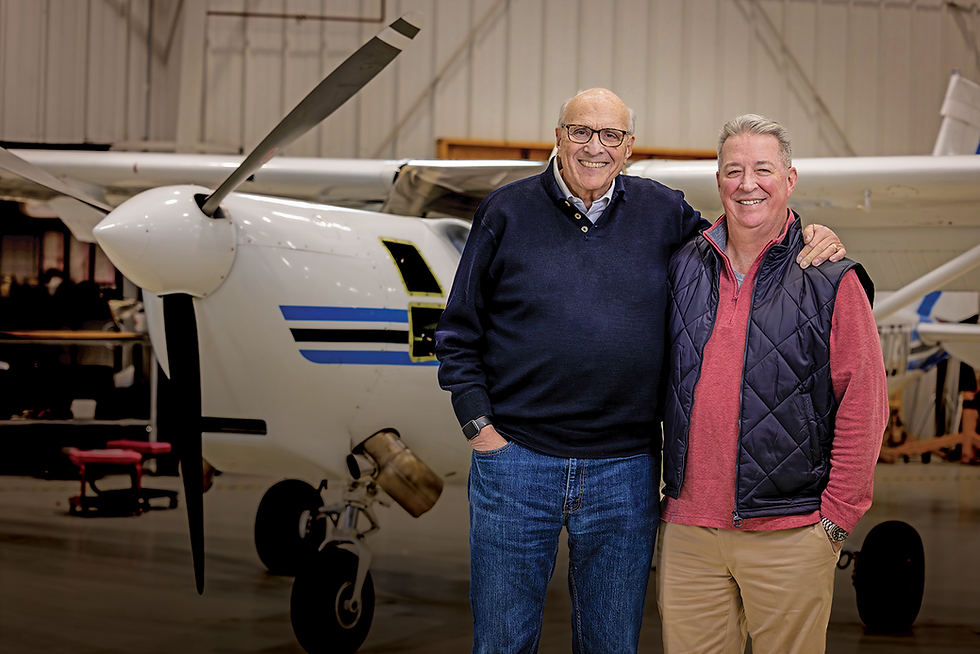
Riding the Currents
Veterans and pilots Neil Planzer and Brian Bruckbauer reflect on their twenty-eight-year friendship.
WRITTEN BY FELICIA SCHNEIDERHAN
PHOTOGRAPHED BY NELS NORQUIST

Neil PLanzer
On a recent summer morning at Wings Airport Café, Planzer and Bruckbauer gathered over pancakes and steaming cups of coffee. The scene was familiar to the two pilots: The tarmac glowing under the blue sky. People coming and going at the small hometown airport. Coffee that just kept coming. Their friendship had taken them from the Pentagon to small airports around the country and back to Lake Country. Bruckbauer had recently moved to northern Minnesota with his wife, Stacye. And Planzer had just taken on the role of interim director of the Brainerd Lakes Regional Airport. The friends had a lot to catch up on. And as always, they were simply glad to be in one another’s presence.
Old friends are like that.
There are all kinds of friendships. Some are deep and heartfelt: friends who’ve known each other since childhood and have been there for each other through many seasons of life. Others are based on circumstances or shared interests. There are friends who like to fish together, who quilt together, or who have kids in the same activities, and friends who share similar goals or values.
Perhaps one of the most intriguing and rare friendships begins with mentorship—one person helping another, growing over time through camaraderie and shared experiences, forming a lifelong bond that’s there when it’s needed most.
Lake Country native Brian Bruckbauer and his mentor Neil Planzer share just that kind of bond. Over nearly three decades, they have shared the opportunities and challenges of serving our nation through some of the most trying times.
Their friendship had taken them from the Pentagon to small airports around the country and back to Lake Country.
Chosen Wisely
A native of Remer, Bruckbauer went to college at the University of St. Thomas in St. Paul, where he was active in the Air Force ROTC and named Distinguished Military Graduate in 1992.
“I had gotten my private pilot’s license but was unable to get a pilot’s slot in the Air Force,” says Bruckbauer. “They were downsizing after Desert Storm.” Instead, he became an air traffic control officer in the Air Force. After his initial training and first few assignments, he was selected for an elite, restricted Air Force internship program that brought fifty captains from all over the United States to Washington, D.C. During the next two years, he earned a master’s degree from George Washington University and served two internships at the Pentagon. One of those internships brought Bruckbauer to the air traffic control office for six months. The person in charge of that office was none other than Neil Planzer.

Brian Bruckbauer
It’s good to have friends who will come get you no matter where you might be.
By the time Bruckbauer walked into Planzer’s office at the Pentagon, Planzer was already a seasoned figure in aviation. A native New Yorker, he’d begun his career as a flight engineer during the Vietnam War and spent the decades since shaping air traffic management at the highest levels, including leadership roles with the Federal Aviation Administration (FAA). By the late 1990s, he was serving in the US Air Force’s Senior Executive Service as executive director of the Department of Defense Policy Board on Federal Aviation, while also holding the role of associate director of Civil Aviation.
Planzer recalls first hearing about the young captain. “I had a colonel who was my deputy, Sheryl Walsh, and she told me she thought he would be really good. She was in the same career field. She said, ‘We can use him.’”
It was good timing. Planzer’s office had quite a challenge. “The FAA had a hiring restriction that led to airmen leaving the military,” Planzer explains. “It was becoming a major issue, to the point it was raised to the Air Force chief of staff office. It filtered down to my office to fix it, so I asked Brian to head that up.”
Bruckbauer worked with the deputy administrator at the FAA to create a whole new system. He was able to coordinate with multiple people across organizations to solve the conundrum with a new program that worked for everyone.
“It was an enormous success for us at the military,” says Planzer. “Brian did a spectacular job. That was the first indication that this was an up-and-coming officer.”
Bruckbauer did so well with the project that the head of Air Force operations at the time, whom Planzer describes as, “a three-star, a little quirky,” told Planzer, “I want him.” Planzer replied, “I got him for another three months.” To which the quirky three-star said, “No, you don’t,” and Brian was moved to the new office.
A few months later, Bruckbauer’s new boss was flying with him in a C-21A (the military version of a Lear 35A aircraft). The quirky three-star wanted to practice some maneuvers he wasn’t allowed to practice with a passenger, and suddenly, Bruckbauer found himself alone, stranded on a tarmac in West Virginia. He considered his options. Then he called the one person he knew had his back.
It’s good to have friends who will come get you no matter where you might be.
Beyond getting him off the tarmac, Planzer was compelled to devote his own resources and energy to help the young captain. Bruckbauer had proven he could work well with multiple groups across organizations, and he could move projects to completion with innovative solutions. These were invaluable skills, plus Bruckbauer had the perseverance to make positive changes. “You’d like to help everybody,” Planzer says, “but you don’t have the capability as an individual to do that. You have to carefully choose those you want to invest your time in. Brian was a person worth every effort I could put forward.”
“The time I had with Neil was very informative for me,” says Bruckbauer. “It was my first exposure to the senior ranks of the Air Force as a junior officer. Neil exposed me not only to what leadership looked like when I was a young officer, but he also helped my understanding of government. He exposed me to a wider network of people. What I learned from Neil was influential in my growth as an officer, and ultimately, my future success. I’ll forever be thankful for that.”
So how does a successful relationship between a mentor and mentee grow into a strong friendship? Especially the kind that lasts twenty-eight years?
Their shared experiences and interests in aviation were important ingredients in their early friendship. “He was an Air Force vet, a prior air traffic controller,” Bruckbauer says. “We had all these things in common. And oh, by the way, he was a really nice guy.”
So how does a successful relationship between a mentor and mentee grow into a strong friendship? Especially the kind that lasts twenty-eight years?
Planzer was there for Bruckbauer in matters both professional and personal. “Neil’s the kind of person who doesn’t think about himself, he only thinks about others. He knew I was going through a hard time as well. More than that, he shared his personal time with me.”
Planzer owned a plane and would invite Bruckbauer to go flying on the weekends. It was a way to keep their passion for flying alive for recreation, for fun. They’d fly out from Maryland and go get a meal somewhere, setting the course for many meals shared in airport cafes. In Planzer’s plane, high above their day-to-day responsibilities on the ground, they shared a new perspective on the world and life. “That bonding time outside of work was foundational for our lifelong friendship,” Bruckbauer says.
Though mentorship remained a strong aspect of the friendship, there are other pillars of the relationship that have sustained it over time. “It’s not one-sided,” says Planzer.
Forged in Hardship
“There have to be some difficult times in order to get tempered steel out of the friendship,” says Planzer. “Then it survives.” Those difficult times, he continues, can be personal or much larger. “They’re all things that lend to the strength of the relationship.”
For Bruckbauer and Planzer, that difficult time came with a national tragedy that affected them both personally and professionally. They were both working at the Pentagon when it was targeted in the 9/11 attack. The trauma of the experience was intensified because they both worked in aviation. What had been a relatively quiet division suddenly became a high-pressure epicenter of national security.
“It’s the only day where all air traffic within the US was on the ground,” Bruckbauer says. “They shut the system down. We were both dealing with that significance.”
Planzer served as key adviser to the US Secretary of Defense and the National Security Council after 9/11. “A lot of things happened after 9/11 to get the system up and running again,” he says. “We went from peace to war in a snap, from an interesting, quiet office at the Pentagon to a hub of attention. Men and women really connected and worked with the FAA to bring the system back and maintain it. We did a lot of things for the protection of the nation.”
Bonded for Life
Eventually, their work took the two friends beyond the Pentagon.
Planzer stayed with the Department of Defense until 2003, then went on to Boeing, where he served in various leadership roles including vice president of air traffic management. In all, he served twenty-five years with the FAA. In 2010, he received the Air Traffic Control Association’s Glen A. Gilbert Memorial Award, one of the most prestigious awards in aviation.
Bruckbauer served twenty-nine years in the US Air Force. He was the Senior Military Assistant to the Under Secretary of Defense for Policy and a Fellow at the Council on Foreign Relations. He retired from the US Air Force as a Brigadier General in 2021. He’s also the first US Air Force core air traffic control officer to achieve General Officer.
“That is a huge deal,” Planzer says. “We should all be very proud of the career he’s had. You in Minnesota should be very proud of your son.”
Though mentorship remained a strong aspect of the friendship, there are other pillars of the relationship that have sustained it over time. “It’s not one-sided,” says Planzer. “I have enjoyed watching him grow and mature, and he has echoed back things he learned to help me grow. We’re both better people for having known each other.”
After retiring, Bruckbauer faced a new challenge, shared by many who leave a long military career. “I was a little bit unclear about what the next step was. Neil was kind enough to help with an opportunity. Then that opportunity helped me to find the job I am in today.” Bruckbauer is now president of Frequentis Defense, a Maryland-based communications and information company that serves US and global military clients.
The role has allowed him to return to his Minnesota roots. Bruckbauer works remotely from the home he and his wife, Stacye (an Alabama native), built in Longville.
Coming Full Circle
In June 2025, Planzer came to Lake Country to serve as interim director of the Brainerd Lakes Regional Airport. On a tarmac in unfamiliar territory, you can guess who he called.
The two met up in their old stomping grounds—an airport café, this time beneath a Lake Country sky.
“With any friendship, time is the test,” says Bruckbauer. “We’re both in different stages of life now. When Neil and I get together, it’s kind of weird. We look older, but it doesn’t necessarily feel different.”
“It’s relaxed,” Planzer says. “The stress of early building in the relationship is done. There’s an ease of time that adds to the value of friendship. It’s been a great asset for both of us. We’ve learned from each other, we’ve grown from what we’ve learned, and that’s the real value.”